UNSDGs and Me

Updated: May 1, 2024
ME, ME AND MORE ABOUT ME
Hello and welcome to my blog. My name is Hasnain a Chemical Engineering student at Singapore Polytechnic and here's where I'll be documenting my Chemical Product Design journey, let me bore you with some of my interests and hobbies so you can paint a better picture of the man behind the blog.

I'm into all sorts of music, from Jazz to Metal or J-Pop. My current favourite song is "Beef Bone Marrow" by Woes, a local Singaporean Math Rock Band. I also play the electric guitar for fun and as a way to relax.

As for reading. I love reading philosophically interesting reads but occasionally I'll relax with just a regular novel. Two of my most recommended reads are "No Longer Human" by Osamu Dazai and "The Alchemist" by Paulo Coelho I hope these details may give readers a better sense of the kind of person writing this blog.
HOPES AND DREAMS
In this section I will set some learning expectations, both for myself and to help readers understand the true purpose of this blog. To consolidate my own learning. Here are my top 3 learning outcomes for this module. And how I will know when I have achieved the set outcome.
Having a more complete understanding of how Chemical Products are developed and the research and development processes behind them. I will know I have achieved a greater understanding when I am able to fully describe the process of creating a Chemical Product from start to finish including the thinking frameworks and thought processes involved
Become more competent in applying chemical engineering principles to solve problems I will know I have achieved competency when I am able to understand how to fully apply the CDIO framework and chemical engineering principles in a practical application to real world problems
HAVING FUN! I will know I have enjoyed my time working through and completing this module when I have finished it and look back on it with fond memories and no regrets!
World's Largest Lesson
Introspecting on the goals and ideas mentioned in the video. I feel the ideas and concrete goals and plans laid out by the United Nations Sustainable Development goals in the video give reason to have a renewed sense of climate-optimism in this current era where most media is constantly soothsaying the end of times. But optimism and hope will only get us so far, so it is just as important to examine them objectively.

There are 17 Goals in total each tackling either a social, economic or environmental issue. They include strategies and the actions that have to be taken by individuals, businesses, communities and governments to achieve certain targets which have also been pre set to help nations have set targets to work towards.

In order to properly evaluvate the sustainable development goals we have to take a closer look at the targets and actions needed to achieve them. For this purpose let us examine Goal 13. Climate Action
The Targets
Target 13.1, Strengthen resilience and adaptive capacity to climate-related hazards and natural disasters in all countries
Indicators of progress
Number of deaths
Number of Missing persons
Number of people directly affected by disasters per 100,000 people.
Target 13.2, Integrate climate change measures into national policies, strategies and planning
Indicators of progress
Number of countries with nationally determined contributions
long-term strategies
national adaptation plans and adaptation communications
Total greenhouse gas emissions per year
Now that we are now familiar with the goal in question let us look at how far we have progressed from its advent. Examining and quoting the progress report published by the United nations
Target 13.1: The number of deaths and missing persons due to disasters per 100,000 population has steadily decreased from 1.64 during 2005-2015 to 0.86 during 2012-2021.... The number of countries with national strategies for disaster risk reduction has increased from 55 in 2015 to 126 by the end of 2021. Based on this, a total of 118 countries have reported having some level of policy coherence with other global frameworks, such as the 2030 Agenda and the Paris Agreement.
Target 13.2: Global temperatures have already hit 1.1°C, rising due to increasing global greenhouse gas emissions, which reached record highs in 2021. Real-time data from 2022 show emissions continuing an upward trajectory. Instead of decreasing emissions as required by the target to limit warming, carbon dioxide levels increased from 2020 to 2021 at a rate higher than the average annual growth rate of the last decade and is already 149% higher than pre-industrial levels. Projected cumulative future CO2 emissions over the lifetime of existing and currently planned fossil fuel infrastructure exceed the total cumulative net CO2 emissions in pathways that limit warming to 1.5°C (>50%) with no or limited overshoot.
From this it is evident that there has been been a sizeable amount of progress in achieving Target 13.1. However, it is still looking quite bleak for Target 13.1

In addition to this. The United Nation's own Progress chart depicts goal 13 as having only fair progress in most targets. Stagnation and regression for one of the targets regarding goal 13.
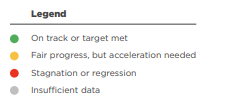
Based on this examination of just one of the goals. I believe it is fair to say that the goals set by the united nations are overly ambitious and with only 6 more years to achieve seemingly impossible targets it is only realistic and rational to abandon the climate-optimism that we were feeling not too long ago. However, I believe that there is still reason to continue to cling onto the hope and optimism for if such overly ambitious goals were never set to begin with perhaps we might not have even made this seemingly small amount of progress.
As such we must continue to cling to this seemingly futile hope, this overly optimistic belief that what we're doing can and will have a difference and continue to put our all into it. For if we simply give in, nothing will ever really change. I am reminded of the quote "Shoot for the moon. Even if you miss, you'll land among the stars" - Norman Vincent Peale
Learning Journey to the National Museum

Me and the rest of my group went to the National Museum to see the exhibition titled "Plastic: Remaking Our World" which took us through the evolution of plastic as a material and its uses, its environmental impact and bleeding edge solutions that enable us as a society to use plastics in a more sustainable way.
The exhibition is split up into 3 different sections which cover the prevalence and uses of plastics in our society over the period of our history.
While all the exhibits were interesting in their own way. Some stood out to me more than others.

This photo in the "Petromodernity" section stood out to me because of its its uniqueness. While art is largely subjective and different people may draw different conclusions and feel different things for certain artworks. I feel like this piece does an excellent job of illustrating the prevalence of plastic use in our society. We truly use it for everything, spoons, ponchos, shoes, chairs, masks, rubbish bags and plastic bags. It stood out the most to me because it really got me thinking about all the things that we make out of plastic just to throw away after a single use. Just how much of that waste is completely avoidable just by putting in a little bit of effort to reuse things?

Another part of the exhibit that stood out to me was this recreation of a house within the museum. It challenged visitors to identify how many daily household objects within the space were made out of plastic. It was truly eye opening and really gave me insight into just how completely dependent we are on plastic for everything. From furniture to basic hygienic needs such as a toothbrush or tooth floss. It is way more prevalent than it may seem
It also made me think about how we as a society would fare if we did not have access to plastics and the convenience and benefits that they provide.
Did you know that digging through dirt and sand with a pair of tweezers for tiny pieces of plastic is surprisingly therapeutic?

In this part of the exhibition there was a table filled with dirt and sand from Punngol beach. But mixed in were tiny bits and pieces of plastic. Our job was to separate these tiny bits of plastic from the sand and dirt using what we had dug out to create an artwork on the plate. Being an engineering student I was completely inept at doing the art part but even still I enjoyed it and found it surprisingly relaxing.
Overall we learned alot as a group and it was truly an eye-opening experience. Just look at how much fun we had in the picture above!.
Our Turn
Given that the ultimate goal and purpose of this journey is to eventually come up with and design a chemical product that solves a problem through applying chemical engineering principles in a practical way.
We as a group began by first identifying a problem to solve. And for that we turn again to the United Nations Sustainable Development goals. We chose two goals that we could best contextualise in the Singapore setting. The goals we chose were Goal 6, Clean water and sanitation. And Goal 11, Sustainable cities and communities.

We chose Goal 6 as we feel it is most relevant to Singapore due to limited space and resources in Singapore, we do not have our own water resources hence we have signed agreements with Malaysia regarding water supply. This agreement will expire in 2061 and Singapore must be self-sufficient in clean water. This is due to the reason that clean water is crucial in resident’s daily life use as well as in the industrial processes. For example, NEWater is a key component of water supply in Singapore. NEWater production went through microfiltration, reverse osmosis and ultraviolet disinfection processes to ensure the quality of water meets requirement of drinking, industrial use and so on. This goal is relevant to Singapore because with clean water and sanitation, people’s health can be maintained. Proper waste treatment also protects the ecosystem from being contaminated

We chose Goal 11 Considering the fact that Singapore is a low-lying island state with very little land. What little land we do have is highly vulnerable to the effects of climate change such as rising sea levels, hotter temperatures, and more irregular and extreme weather events. As such, it is important to ensure that our cities are developed and run in such in a way that they are resilient to the negative changes brought on by climate change, adopt greener technologies and reduce carbon emissions all to mitigate the effects of climate change on cities and ensure that they remain safe, liveable and sustainable. For instance, Singapore has rolled out the Singapore Green Plan which aims to reduce Singapore’s carbon footprint, embrace green technologies in urban development and make sustainable living more feasible by setting goals like those of the UN SDGs. Therefore Goal 11 is highly relevant to Singapore.
THE GAME PLAN
After much deliberation over which Goal we are able to contribute the most to using our chemical engineering knowledge it was pretty clear to us we had to choose Goal 6, clean water and sanitation as the best way to apply our current knowledge of chemical processes to the CDIO (Conceive, Design, Implement and Operate) framework with the intention of creating a functional water filter that is able to filter microplastics aswell as disinfect it making it drinkable and better suited for both domestic and industrial uses.
We felt that this was the best choice as all of us have some experience in designing a water filter and the principles that into it from an experiment in our Laboratory and Process Skills 1 module although most of us only had limited success in creating a realistically functional filter back then. Therefore, it only made sense that we would use the knowledge that we have gained since then to try our hand at it again this time slightly older and hopefully a lot more wiser and with much more success this time.
This concludes BLOG #1 of my Chemical Product Design Journey. I hope you had enjoyable time reading it and stay tuned for the next one!


Comments